Text to imageSpace & architectureStyle guide
A Reading Nook Behind Bell-Tower Louvers
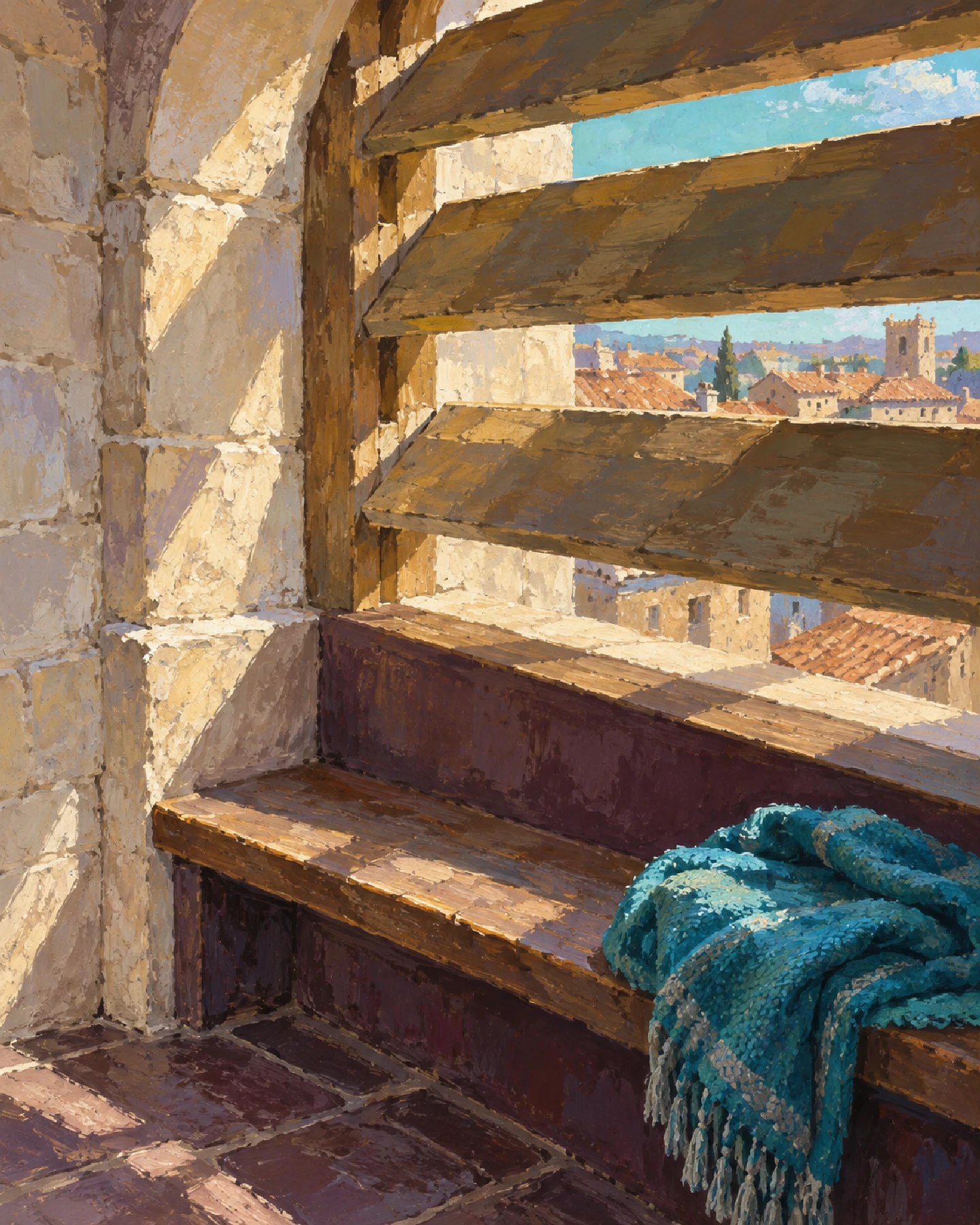
A small reading nook occupies the deep louvered opening of an old bell tower. Closely cropped timber blades and opaque gouache brushwork reveal its depth and quiet.
Remix this referenceA Reading Nook Behind Bell-Tower Louvers
- Form language
- Simplify architecture into broad, slightly irregular planes; allow small details to dissolve into larger painted shapes.
- Contour
- Let loaded brush edges define forms, alternating crisp cutbacks with soft lost edges rather than continuous ink outlines.
- Mark-making
- Use loose opaque gouache strokes with visible bristle drag, broad overlapping sweeps and occasional dry skips.
- Surface rendering
- Model tone with layered opaque patches and selective wet blending; let underpainting peek through unevenly.
Priority
Loose gouache with visible opaque brushwork.
What to avoid & what to check
Exact prompt for this example
MODULE OWNERSHIP
subject: Subject count, type, stable proportions and landmarks, resting face geometry, hair shape, physical materials, garment construction and permanent marks. No emotion, movement, color assignment or rendering recipe.
expression: Facial soft-tissue displacement and pupil direction, muscle coordination, regional intensity, asymmetry and onset/peak/release. No head/body pose, stable appearance, skin color or rendering.
gesture: Head/neck/body/limb orientation, joint movement, support, contact and pose-caused occlusion using existing anatomy. No eye/pupil movement, emotion, identity, props inventory or camera.
props: Prop count, type, construction, physical material and scale relative to the subject. Holding/contact belongs to gesture, position to composition, color to palette.
scene: Environment elements, terrain, backdrop/floor presence and structural detail. No canvas positions, camera, lighting, assigned colors or render texture.
camera: Projection, focal-length impression, camera elevation/yaw/roll, viewing distance and crop. No actor pose, world placement, lighting or canvas aspect ratio.
composition: Normalized 0-100% canvas positions, scale in frame, depth/overlap, focal hierarchy and margins. No joint pose, camera projection, rendering, subject/prop inventory or emotion.
palette: Color anchors, hue/saturation/value ranges, colors assigned to parts and approximate color coverage. No illumination direction, shading algorithm, physical material or layout.
lighting: Light-source direction/softness/intensity, ambient illumination, physical shadow direction/length and highlight position. Absence of directional illumination is allowed. No shading technique, palette or material changes.
style: Reusable form abstraction, contour weight/taper/edge quality, medium and mark scale/density/direction, surface rendering and tonal transition technique. No fixed subject proportions, anatomy, identity, expression, pose, palette, light-source direction, camera or layout.
output: Image count, aspect ratio, size, file/alpha requirements and global lettering/logo/watermark restrictions. No background scenery, crop, style, identity or pose.

SUBJECT
inventory: No people, animals or character subjects.
geometry: No figurative proportions or anatomical landmarks apply.
resting-face: No face is present.
appearance: No character appearance or garments apply.

PRIORITY


AVOID


CHECK


PROPS
inventory: One loosely folded wool blanket, small relative to the reading bench.
construction: A thick woven blanket with a soft bound edge and naturally uneven folds.

PRIORITY


AVOID


CHECK


SCENE
inventory: An adapted bell-tower alcove with timber louvers, a built-in reading bench, masonry reveals and distant tiled roofs.
structure: A deep arched opening holds broad sloping louver blades; the bench extends into its recess above a worn stone floor.

PRIORITY


AVOID


CHECK


CAMERA
projection: Natural perspective with a normal-lens impression and no exaggerated convergence.
viewpoint: Look obliquely into the recess from seated eye height and close viewing distance.
crop: Crop through the nearest louver blade and outer arch, retaining the bench surface and a small glimpse outdoors.

PRIORITY


AVOID


CHECK


COMPOSITION
placement: The bench recess fills the lower right; its inner corner is the focal point, with the blanket at one bench end near the lower edge.
depth: A large foreground blade overlaps the opening; successive blades reveal narrow intervals of distant rooftops.
spacing: Keep the upper-left masonry broad and quiet, balancing the compressed layers around the intimate bench corner.

PRIORITY


AVOID


CHECK


PALETTE
colors: Chalk cream, muted aubergine, weathered ochre and a small clear turquoise accent.
assignment: Cream masonry, ochre timber and roofs, aubergine stone floor and bench recess, turquoise blanket.
balance: Keep the architecture mostly muted; reserve the clearest saturation for the small textile accent.

PRIORITY


AVOID


CHECK


LIGHTING
sources: Soft afternoon daylight enters from upper left through the louver opening, with low ambient fill.
shadows: Broad blade shadows fall diagonally down and right across the bench, softening deeper inside the recess.
highlights: Light rests on the exposed bench lip, upper blanket folds and outward-facing masonry edges.

PRIORITY


AVOID


CHECK


STYLE GUIDE
form-language: Simplify architecture into broad, slightly irregular planes; allow small details to dissolve into larger painted shapes.
contour: Let loaded brush edges define forms, alternating crisp cutbacks with soft lost edges rather than continuous ink outlines.
mark-making: Use loose opaque gouache strokes with visible bristle drag, broad overlapping sweeps and occasional dry skips.
surface-rendering: Model tone with layered opaque patches and selective wet blending; let underpainting peek through unevenly.

PRIORITY
Loose gouache with visible opaque brushwork.

AVOID


CHECK


OUTPUT
format: One finished image, portrait 4:5, 1440 × 1800 pixels, opaque PNG.
restrictions: No lettering, logos or watermarks.

PRIORITY


AVOID


CHECK


FINAL INTEGRATION
scene + camera + composition + style: Let architectural structure, close observation and painted simplification support a coherent sense of inhabitable depth.
Model information comes from image provenance. The same prompt may produce a different result.