Text to imageArt stylesStyle guide
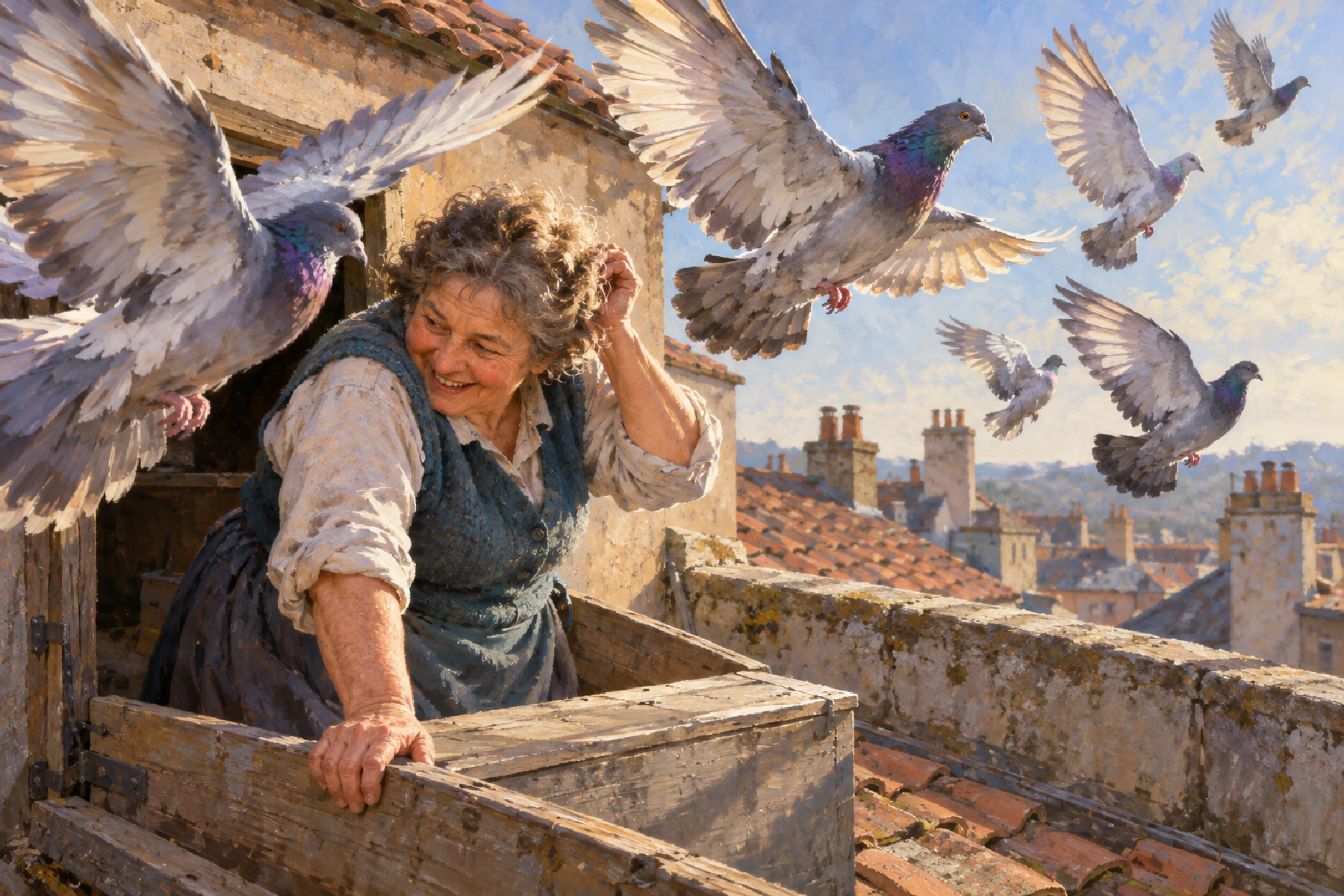
Pigeons Taking Flight at the Roof Hatch
A pigeon keeper ducks with a smile as birds spill through a roof hatch. Translucent paint layers, flowing tonal transitions and light filtering between wings envelop the sudden commotion.
Remix this referencePigeons Taking Flight at the Roof Hatch
- Form language
- Build rounded, interlocking masses from broad painterly shapes; simplify minor detail while allowing irregular silhouettes.
- Contour
- Replace enclosing outlines with alternating lost edges and short, firm brush edges; let boundaries merge selectively.
- Mark-making
- Use broad dragged bristle strokes with occasional smaller broken touches; vary their pressure and length naturally.
- Surface rendering
- Layer translucent oil-like veils over softly blended continuous tones; retain occasional opaque scumbles within the luminous surface.
Priority
Preserve luminous continuous-tone painting while keeping individual brush decisions visible.
What to avoid & what to check
Exact prompt for this example
MODULE OWNERSHIP
subject: Subject count, type, stable proportions and landmarks, resting face geometry, hair shape, physical materials, garment construction and permanent marks. No emotion, movement, color assignment or rendering recipe.
expression: Facial soft-tissue displacement and pupil direction, muscle coordination, regional intensity, asymmetry and onset/peak/release. No head/body pose, stable appearance, skin color or rendering.
gesture: Head/neck/body/limb orientation, joint movement, support, contact and pose-caused occlusion using existing anatomy. No eye/pupil movement, emotion, identity, props inventory or camera.
props: Prop count, type, construction, physical material and scale relative to the subject. Holding/contact belongs to gesture, position to composition, color to palette.
scene: Environment elements, terrain, backdrop/floor presence and structural detail. No canvas positions, camera, lighting, assigned colors or render texture.
camera: Projection, focal-length impression, camera elevation/yaw/roll, viewing distance and crop. No actor pose, world placement, lighting or canvas aspect ratio.
composition: Normalized 0-100% canvas positions, scale in frame, depth/overlap, focal hierarchy and margins. No joint pose, camera projection, rendering, subject/prop inventory or emotion.
palette: Color anchors, hue/saturation/value ranges, colors assigned to parts and approximate color coverage. No illumination direction, shading algorithm, physical material or layout.
lighting: Light-source direction/softness/intensity, ambient illumination, physical shadow direction/length and highlight position. Absence of directional illumination is allowed. No shading technique, palette or material changes.
style: Reusable form abstraction, contour weight/taper/edge quality, medium and mark scale/density/direction, surface rendering and tonal transition technique. No fixed subject proportions, anatomy, identity, expression, pose, palette, light-source direction, camera or layout.
output: Image count, aspect ratio, size, file/alpha requirements and global lettering/logo/watermark restrictions. No background scenery, crop, style, identity or pose.

SUBJECT
inventory: A: one older woman pigeon keeper; six adult domestic pigeons form an unbound ensemble.
geometry: The keeper has a compact, sturdy build; the pigeons have full breasts, small heads and broad tapered wings.
resting-face: A has broad cheekbones, a rounded nose tip, a wide mouth and a fuller lower lip.
appearance: A has short coiled hair and wears a wool vest over a cotton work shirt; the pigeons have layered feathers.

PRIORITY


AVOID


CHECK


EXPRESSION — ACTOR A
brows: Brows lift slightly, with one outer end higher.
lids: Lower lids rise into a gentle squint.
cheeks: Cheeks bunch upward beneath the eyes.
nose: Nostrils remain relaxed without a nose wrinkle.
mouth: Both corners rise into a broad, slightly open smile.
jaw: Jaw releases just enough to part the lips.
gaze: Pupils track the nearest passing pigeon.
coordination: Cheek lift supports the smile; the brow asymmetry stays subtle.
timing: Capture the apex of a spontaneous amused reaction.

PRIORITY


AVOID


CHECK


GESTURE
head: A tucks her chin and lowers her head toward one raised shoulder beneath the passing wings.
torso: She bends slightly at the waist and twists aside while keeping her weight over planted feet.
limbs: One forearm rises beside her head; the other arm reaches down. The flock alternates spread and folding wings.
contact: Her lower palm braces on the hatch rim; the raised sleeve partly hides her neck. Birds pass without touching her.

PRIORITY


AVOID


CHECK


PROPS
inventory: No separate props.
construction: No prop construction applies.

PRIORITY


AVOID


CHECK


SCENE
inventory: A working rooftop pigeon loft with an open access hatch, a low parapet and distant chimney roofs.
structure: The hatch has a thick timber curb; weathered roof tiles meet the loft's plain plaster wall.

PRIORITY


AVOID


CHECK


CAMERA
projection: Natural perspective with a moderately wide lens impression.
viewpoint: View from just above hatch height, obliquely across the rooftop, with a level camera.
crop: Use a medium-wide view retaining A's supporting stance; let one nearest wing extend beyond the frame.

PRIORITY


AVOID


CHECK


COMPOSITION
placement: Place A left of center above the hatch; sweep the flock diagonally toward the open upper-right area.
depth: Overlap nearby wings across the sleeve and hatch; separate smaller distant birds against the roofline.
spacing: Make the face and surrounding wing gaps the first read; leave generous breathing room beyond the flight path.

PRIORITY


AVOID


CHECK


PALETTE
colors: Anchor the image in smoky violet, pearl gray, apricot and muted petrol blue.
assignment: Use pearl and violet for birds, petrol blue for the vest, apricot for skin and plaster, and muted clay for tiles.
balance: Let subdued cool hues dominate, with restrained warm accents and a few pale feather notes.

PRIORITY


AVOID


CHECK


LIGHTING
sources: Broad early sunlight enters from the upper left; soft sky illumination opens the sheltered areas.
shadows: Wing shadows fall softly across the shirt; roof shadows stretch toward the lower right.
highlights: Light catches upper feather edges, the cheek ridge and the hatch rim; thin feather tips transmit light.

PRIORITY


AVOID


CHECK


STYLE GUIDE
form-language: Build rounded, interlocking masses from broad painterly shapes; simplify minor detail while allowing irregular silhouettes.
contour: Replace enclosing outlines with alternating lost edges and short, firm brush edges; let boundaries merge selectively.
mark-making: Use broad dragged bristle strokes with occasional smaller broken touches; vary their pressure and length naturally.
surface-rendering: Layer translucent oil-like veils over softly blended continuous tones; retain occasional opaque scumbles within the luminous surface.

PRIORITY
Preserve luminous continuous-tone painting while keeping individual brush decisions visible.

AVOID


CHECK


OUTPUT
format: One finished image, landscape 3:2, 1800 × 1200 pixels, PNG with an opaque background.
restrictions: No lettering, logos, signatures or watermarks.

PRIORITY


AVOID


CHECK


FINAL INTEGRATION
gesture + composition: Keep the overlapping flight readable through the keeper's uninterrupted support and the spaces between wings.
lighting + style: Translate the illumination into the layered paint without dissolving every structural edge.
Model information comes from image provenance. The same prompt may produce a different result.