Text to imageArt stylesStyle guide
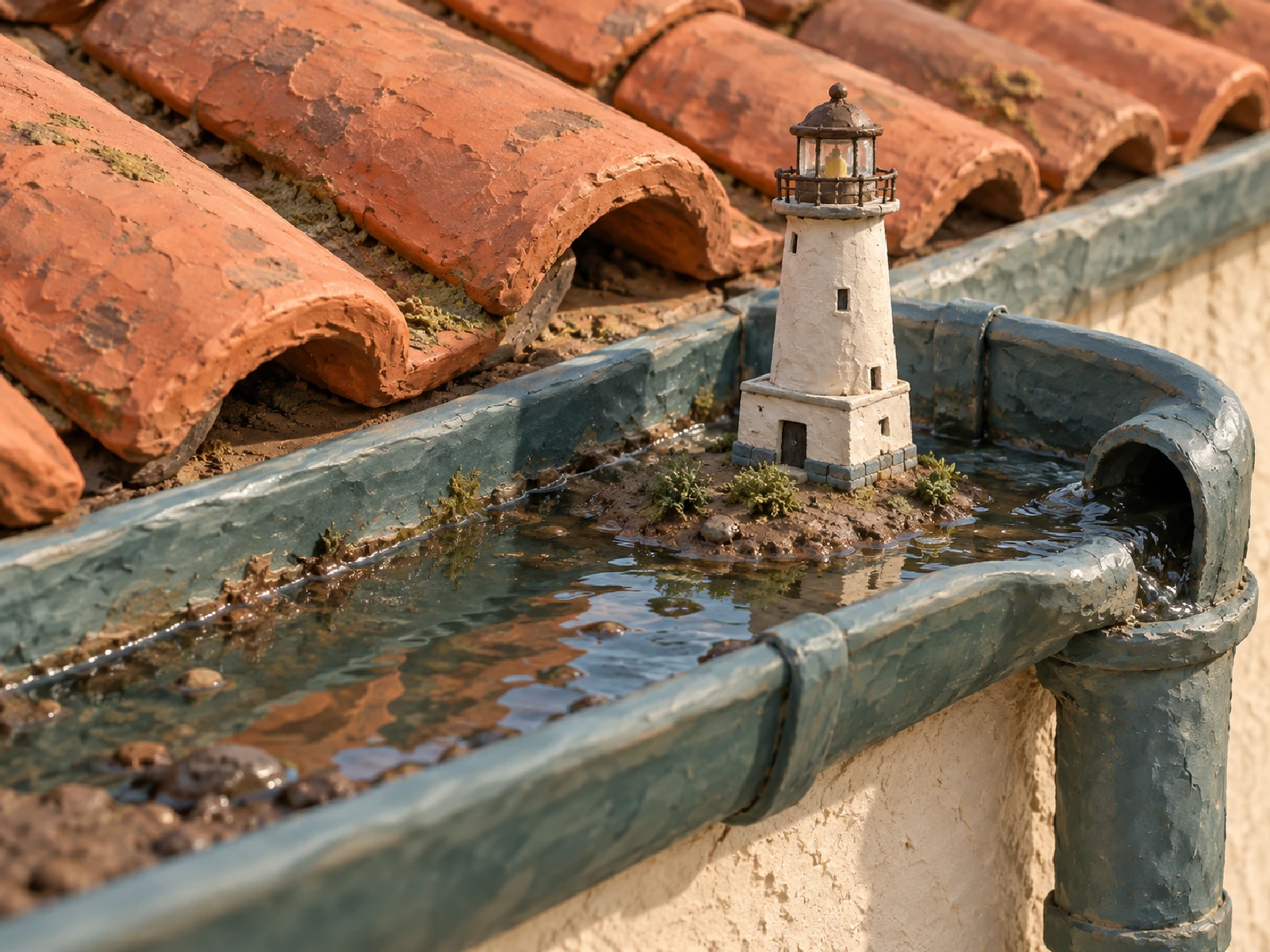
A Lighthouse in the Rain Gutter
A roof gutter becomes a tiny coastline. A lighthouse on a silt island and outsized roof tiles create an unexpected scale shift in a tactile, handbuilt clay miniature.
Remix this referenceA Lighthouse in the Rain Gutter
- Form language
- Assemble the miniature from pinched clay masses and pressed slabs; simplify small detail into readable relief while allowing uneven handmade transitions.
- Contour
- Use rounded sculptural boundaries without drawn outlines; vary rim thickness naturally and keep occasional thumb-softened corners.
- Mark-making
- Let occasional finger dents and short modeling-tool drags follow local surfaces; vary their spacing and strength instead of applying uniform texture.
- Surface rendering
- Give matte clay broad, softly rolling tonal transitions, with rubbed patches and shallow raised details that remain visibly part of the sculpted surface.
Priority
The finished image must visibly read as a tactile, handbuilt clay miniature.
What to avoid & what to check
Exact prompt for this example
MODULE OWNERSHIP
subject: Subject count, type, stable proportions and landmarks, resting face geometry, hair shape, physical materials, garment construction and permanent marks. No emotion, movement, color assignment or rendering recipe.
expression: Facial soft-tissue displacement and pupil direction, muscle coordination, regional intensity, asymmetry and onset/peak/release. No head/body pose, stable appearance, skin color or rendering.
gesture: Head/neck/body/limb orientation, joint movement, support, contact and pose-caused occlusion using existing anatomy. No eye/pupil movement, emotion, identity, props inventory or camera.
props: Prop count, type, construction, physical material and scale relative to the subject. Holding/contact belongs to gesture, position to composition, color to palette.
scene: Environment elements, terrain, backdrop/floor presence and structural detail. No canvas positions, camera, lighting, assigned colors or render texture.
camera: Projection, focal-length impression, camera elevation/yaw/roll, viewing distance and crop. No actor pose, world placement, lighting or canvas aspect ratio.
composition: Normalized 0-100% canvas positions, scale in frame, depth/overlap, focal hierarchy and margins. No joint pose, camera projection, rendering, subject/prop inventory or emotion.
palette: Color anchors, hue/saturation/value ranges, colors assigned to parts and approximate color coverage. No illumination direction, shading algorithm, physical material or layout.
lighting: Light-source direction/softness/intensity, ambient illumination, physical shadow direction/length and highlight position. Absence of directional illumination is allowed. No shading technique, palette or material changes.
style: Reusable form abstraction, contour weight/taper/edge quality, medium and mark scale/density/direction, surface rendering and tonal transition technique. No fixed subject proportions, anatomy, identity, expression, pose, palette, light-source direction, camera or layout.
output: Image count, aspect ratio, size, file/alpha requirements and global lettering/logo/watermark restrictions. No background scenery, crop, style, identity or pose.

SUBJECT
inventory: One miniature coastal lighthouse; no people or animals.
geometry: A tapering cylindrical tower rises from a squat square base, with an overhanging gallery and a capped lantern room.
resting-face: No face or facial landmarks apply.
appearance: Masonry tower, metal gallery and lantern frame, and glass panes; no permanent identifying marks.

PRIORITY


AVOID


CHECK


PROPS
inventory: No separate props.
construction: No prop construction applies.

PRIORITY


AVOID


CHECK


SCENE
inventory: A domestic roof corner with curved tiles, an open rain gutter, a plaster wall, pooled rainwater and a silt islet.
structure: The gutter bends around the roof corner; its water surrounds the islet and narrows toward an open downpipe mouth.

PRIORITY


AVOID


CHECK


CAMERA
projection: Perspective with a moderately long focal-length impression and restrained depth exaggeration.
viewpoint: An elevated three-quarter view looks along the gutter and into its bend; keep the camera level in roll.
crop: A close architectural detail includes several tile rows, the complete gutter bend and a strip of wall beneath.

PRIORITY


AVOID


CHECK


COMPOSITION
placement: Set the lighthouse near the right third; the gutter sweeps from the lower left toward it, with roof tiles above.
depth: Overlap the distant gutter rim with the tower base; nearby tile ends appear much larger than the lantern room.
spacing: Make the tower the first read and the drain opening the second; leave water around the island and air above the cap.

PRIORITY


AVOID


CHECK


PALETTE
colors: Use terracotta, petrol blue-green, chalk ivory and earth umber, with mostly muted saturation.
assignment: Terracotta tiles, blue-green gutter and water, ivory tower and wall, and umber silt and lantern cap.
balance: Warm roof colors occupy the largest area; the darker water contrasts with the small, pale tower.

PRIORITY


AVOID


CHECK


LIGHTING
sources: Broad soft daylight enters from the upper left, with gentle ambient fill inside the gutter.
shadows: Short, soft shadows fall toward the lower right; contact shadows remain visible beneath projecting edges.
highlights: Broad highlights sit on upper-left-facing ridges, with restrained glints on the lantern panes.

PRIORITY


AVOID


CHECK


STYLE GUIDE
form-language: Assemble the miniature from pinched clay masses and pressed slabs; simplify small detail into readable relief while allowing uneven handmade transitions.
contour: Use rounded sculptural boundaries without drawn outlines; vary rim thickness naturally and keep occasional thumb-softened corners.
mark-making: Let occasional finger dents and short modeling-tool drags follow local surfaces; vary their spacing and strength instead of applying uniform texture.
surface-rendering: Give matte clay broad, softly rolling tonal transitions, with rubbed patches and shallow raised details that remain visibly part of the sculpted surface.

PRIORITY
The finished image must visibly read as a tactile, handbuilt clay miniature.

AVOID


CHECK


OUTPUT
format: One opaque PNG image, 4:3 aspect ratio, 1600 × 1200 pixels.
restrictions: No lettering, logos, signatures or watermarks.

PRIORITY


AVOID


CHECK


FINAL INTEGRATION
subject + scene + composition: The familiar roof structure supplies scale cues that let the lighthouse read as an unexpectedly tiny coastal building.
Model information comes from image provenance. The same prompt may produce a different result.