Text to imageCharacterStyle guide
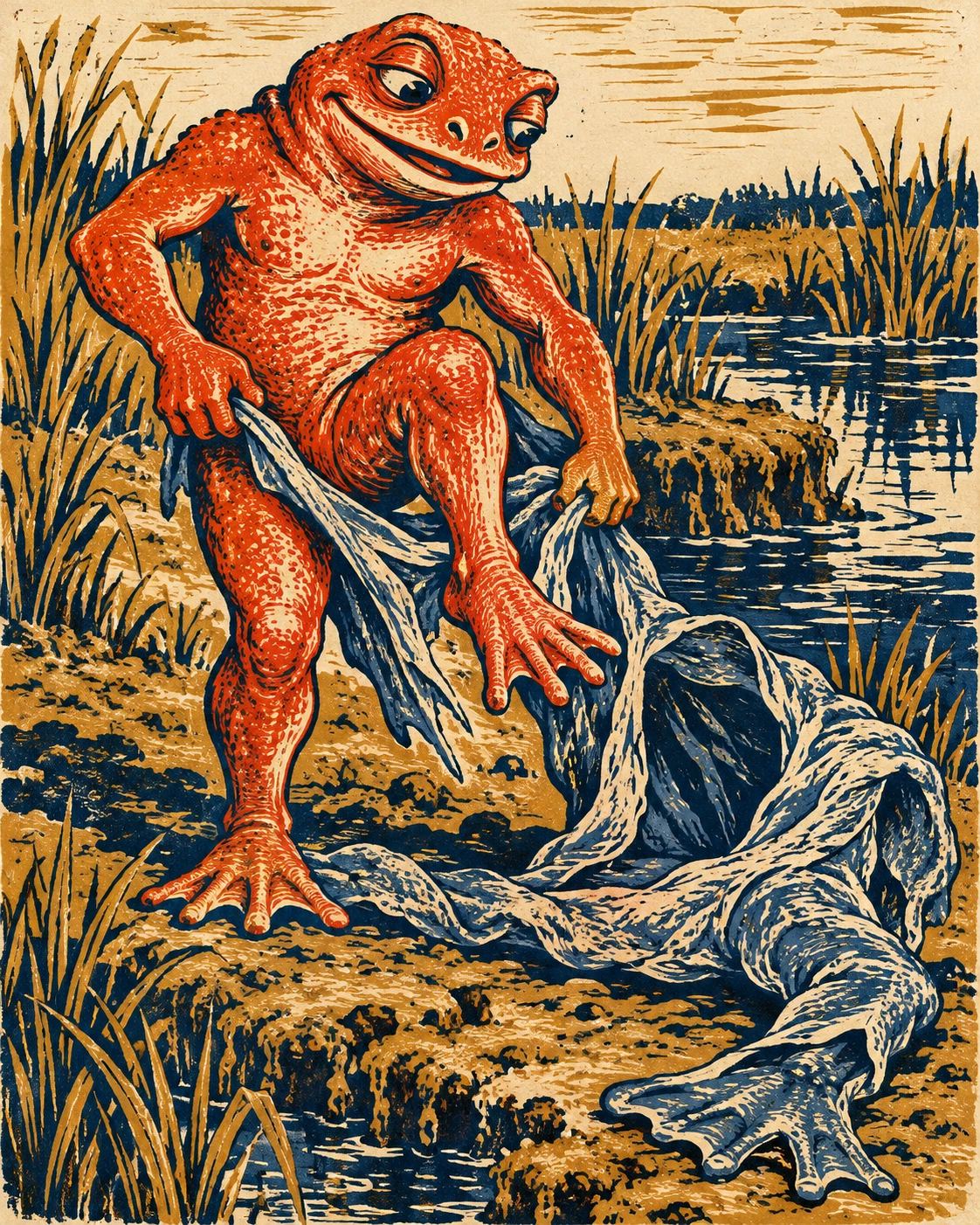
A Creature Stepping Out of Its Skin
A spade-headed creature steps out of its old skin on a marsh bank. Bold linocut gouges bind the tangled husk and emerging body into a lively narrative.
Remix this referenceA Creature Stepping Out of Its Skin
- Form language
- Reduce forms to weighty interlocking masses and expressive cutouts; preserve elastic irregularity rather than geometric uniformity.
- Contour
- Use stout, slightly bitten edges that swell and break where the cutting tool changes pressure.
- Mark-making
- Carve sweeping gouges against shorter hooked cuts; let spacing and depth vary with a decisive hand-cut rhythm.
- Surface rendering
- Build tones from printed ink masses and exposed paper cuts, with uneven ink bite and modest registration drift.
Priority
Make bold linocut carving visibly shape the image.
What to avoid & what to check
Exact prompt for this example
MODULE OWNERSHIP
subject: Subject count, type, stable proportions and landmarks, resting face geometry, hair shape, physical materials, garment construction and permanent marks. No emotion, movement, color assignment or rendering recipe.
expression: Facial soft-tissue displacement and pupil direction, muscle coordination, regional intensity, asymmetry and onset/peak/release. No head/body pose, stable appearance, skin color or rendering.
gesture: Head/neck/body/limb orientation, joint movement, support, contact and pose-caused occlusion using existing anatomy. No eye/pupil movement, emotion, identity, props inventory or camera.
props: Prop count, type, construction, physical material and scale relative to the subject. Holding/contact belongs to gesture, position to composition, color to palette.
scene: Environment elements, terrain, backdrop/floor presence and structural detail. No canvas positions, camera, lighting, assigned colors or render texture.
camera: Projection, focal-length impression, camera elevation/yaw/roll, viewing distance and crop. No actor pose, world placement, lighting or canvas aspect ratio.
composition: Normalized 0-100% canvas positions, scale in frame, depth/overlap, focal hierarchy and margins. No joint pose, camera projection, rendering, subject/prop inventory or emotion.
palette: Color anchors, hue/saturation/value ranges, colors assigned to parts and approximate color coverage. No illumination direction, shading algorithm, physical material or layout.
lighting: Light-source direction/softness/intensity, ambient illumination, physical shadow direction/length and highlight position. Absence of directional illumination is allowed. No shading technique, palette or material changes.
style: Reusable form abstraction, contour weight/taper/edge quality, medium and mark scale/density/direction, surface rendering and tonal transition technique. No fixed subject proportions, anatomy, identity, expression, pose, palette, light-source direction, camera or layout.
output: Image count, aspect ratio, size, file/alpha requirements and global lettering/logo/watermark restrictions. No background scenery, crop, style, identity or pose.

SUBJECT
inventory: One original adult amphibious biped.
geometry: A broad spade-shaped head joins a short neck, pear-like torso, paddle hands and broad splayed feet.
resting-face: Wide-set eyes sit beneath a shallow brow ridge, above slit nostrils and a long horizontal mouth.
appearance: Hairless, finely pebbled hide has a small raised ridge along the back; there are no garments.

PRIORITY


AVOID


CHECK


EXPRESSION — ACTOR A
brows: The brow ridge relaxes, with one side still slightly raised.
lids: Lower lids lift gently while upper lids soften downward.
cheeks: Cheeks retain a small upward bunch beside the mouth.
nose: The nostril slits remain relaxed without wrinkling.
mouth: An uneven open smile begins to settle, one corner lingering higher.
jaw: The jaw hangs slightly loose as facial tension releases.
gaze: Pupils angle downward toward the newly freed foot.
coordination: The softening eyes and lingering smile release together.
timing: Show relief releasing immediately after the last tight pull.

PRIORITY


AVOID


CHECK


GESTURE
head: The head dips and turns toward the leg emerging from the husk.
torso: The torso twists sideways in a shallow forward lean.
limbs: One knee lifts clear while the other leg supports the body; the hands pull the split husk apart.
contact: The planted foot pins the trailing membrane; one loose skin sleeve overlaps the supporting shin.

PRIORITY


AVOID


CHECK


PROPS
inventory: One empty shed skin, approximately the creature's own size.
construction: A thin flexible skin membrane has an open back split and collapsed limb sleeves; it is an empty husk.

PRIORITY


AVOID


CHECK


SCENE
inventory: A marsh bank with sedge tussocks, exposed mud and a shallow pool.
structure: An uneven earthen shelf meets a narrow water channel, with sparse roots emerging from its broken edge.

PRIORITY


AVOID


CHECK


CAMERA
projection: Use a gently compressed perspective with little near-to-far size distortion.
viewpoint: View from slightly above at a three-quarter angle, without camera roll.
crop: A close full-figure view includes both feet and the complete shed skin.

PRIORITY


AVOID


CHECK


COMPOSITION
placement: The emerging body rises left of center; the emptied husk sweeps across the lower right.
depth: The husk overlaps the legs, near sedges interrupt the bank edge, and the water recedes behind them.
spacing: Lead with the face and freed foot, then follow the husk's loop; preserve open gaps between the overlapping masses.

PRIORITY


AVOID


CHECK


PALETTE
colors: Vermilion, deep indigo, dry ochre and warm paper cream create a forceful limited palette.
assignment: Assign vermilion to the creature, indigo to the husk and water, ochre to earth and sedges, and cream to open intervals.
balance: Keep vermilion concentrated and ochre subdued, with indigo providing the strongest dark anchor.

PRIORITY


AVOID


CHECK


LIGHTING
sources: Soft daylight comes from upper right, supported by moderate ambient illumination.
shadows: A broad soft cast shadow extends leftward across the bank; folds contain short deeper shadows.
highlights: Broad highlights touch the forehead, upper shoulder and raised knee.

PRIORITY


AVOID


CHECK


STYLE GUIDE
form-language: Reduce forms to weighty interlocking masses and expressive cutouts; preserve elastic irregularity rather than geometric uniformity.
contour: Use stout, slightly bitten edges that swell and break where the cutting tool changes pressure.
mark-making: Carve sweeping gouges against shorter hooked cuts; let spacing and depth vary with a decisive hand-cut rhythm.
surface-rendering: Build tones from printed ink masses and exposed paper cuts, with uneven ink bite and modest registration drift.

PRIORITY
Make bold linocut carving visibly shape the image.

AVOID


CHECK


OUTPUT
format: One finished image, portrait 4:5, 1638 × 2048 pixels, opaque PNG.
restrictions: No lettering, logos or watermarks.

PRIORITY


AVOID


CHECK


FINAL INTEGRATION
gesture + props + composition: Make the interaction and overlaps establish that the husk is empty.
expression + style: Preserve the facial acting through the print's abstraction.
Model information comes from image provenance. The same prompt may produce a different result.