Text to imageIllustrationStyle guide
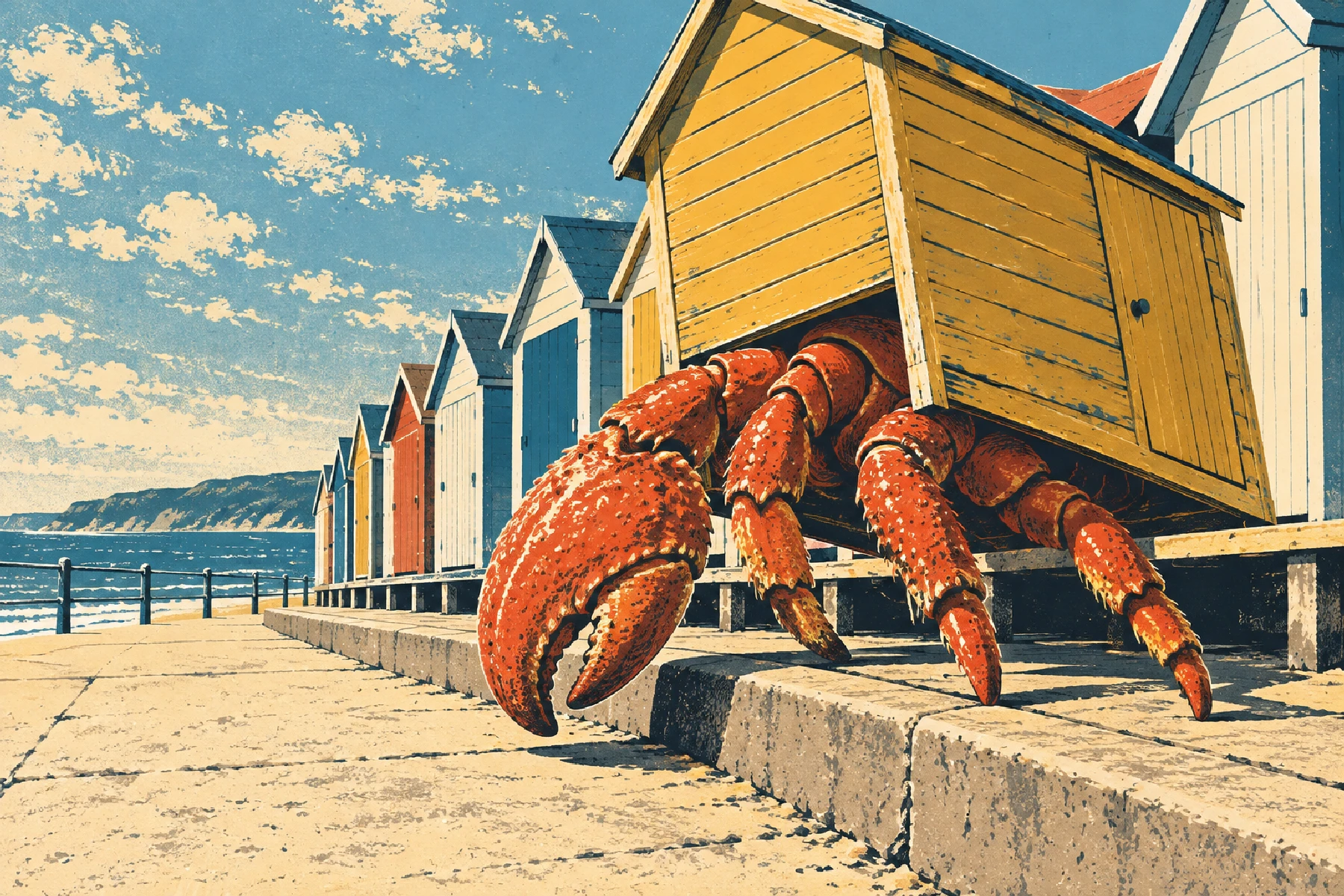
A Hermit Crab Carrying a Beach Hut
An enormous hermit crab negotiates a promenade curb beneath a tilting beach hut. Decisive screenprinted shapes and rough ink overlaps bring everyday architecture into collision with an unexpected inhabitant.
Remix this referenceA Hermit Crab Carrying a Beach Hut
- Form language
- Reduce forms into interlocking wedges, broad arcs and blunt blocks; repeated shapes establish decisive graphic rhythms.
- Contour
- Let ink silhouettes carry most edges, with occasional thick broken keylines and slight hand-cut irregularity.
- Mark-making
- Use sparse dragged ink streaks and uneven stencil bites; their size and spacing may vary naturally within the same graphic language.
- Surface rendering
- Build screenprinted surfaces from opaque ink layers, occasional translucent overlaps and exposed paper; use stepped tonal changes.
Priority
Preserve the decisive shape rhythms and tactile ink overlaps of a graphic screen print.
What to avoid & what to check
Exact prompt for this example
MODULE OWNERSHIP
subject: Subject count, type, stable proportions and landmarks, resting face geometry, hair shape, physical materials, garment construction and permanent marks. No emotion, movement, color assignment or rendering recipe.
expression: Facial soft-tissue displacement and pupil direction, muscle coordination, regional intensity, asymmetry and onset/peak/release. No head/body pose, stable appearance, skin color or rendering.
gesture: Head/neck/body/limb orientation, joint movement, support, contact and pose-caused occlusion using existing anatomy. No eye/pupil movement, emotion, identity, props inventory or camera.
props: Prop count, type, construction, physical material and scale relative to the subject. Holding/contact belongs to gesture, position to composition, color to palette.
scene: Environment elements, terrain, backdrop/floor presence and structural detail. No canvas positions, camera, lighting, assigned colors or render texture.
camera: Projection, focal-length impression, camera elevation/yaw/roll, viewing distance and crop. No actor pose, world placement, lighting or canvas aspect ratio.
composition: Normalized 0-100% canvas positions, scale in frame, depth/overlap, focal hierarchy and margins. No joint pose, camera projection, rendering, subject/prop inventory or emotion.
palette: Color anchors, hue/saturation/value ranges, colors assigned to parts and approximate color coverage. No illumination direction, shading algorithm, physical material or layout.
lighting: Light-source direction/softness/intensity, ambient illumination, physical shadow direction/length and highlight position. Absence of directional illumination is allowed. No shading technique, palette or material changes.
style: Reusable form abstraction, contour weight/taper/edge quality, medium and mark scale/density/direction, surface rendering and tonal transition technique. No fixed subject proportions, anatomy, identity, expression, pose, palette, light-source direction, camera or layout.
output: Image count, aspect ratio, size, file/alpha requirements and global lettering/logo/watermark restrictions. No background scenery, crop, style, identity or pose.

SUBJECT
inventory: One enormous hermit crab, actor A; no people or other animals.
geometry: A compact forebody, unequal claws including one broad claw, and tapering jointed walking legs.
resting-face: Resting facial geometry is left unspecified.
appearance: A hard segmented exoskeleton with knobby joints and lightly pitted plates; no permanent markings.

PRIORITY


AVOID


CHECK


EXPRESSION — ACTOR A
brows: Brow displacement is unprescribed.
lids: Lid displacement is unprescribed.
cheeks: Cheek displacement is unprescribed.
nose: Nasal displacement is unprescribed.
mouth: Mouthpart displacement is unprescribed.
jaw: Jaw movement is unprescribed.
gaze: Pupil direction is unprescribed.
coordination: No facial coordination or asymmetry is prescribed.
timing: No facial transition is prescribed at the neutral apex.

PRIORITY


AVOID


CHECK


GESTURE
head: A faces away, leaving its facial region, including eyes and mouthparts, concealed beneath the overhanging hut.
torso: A pitches its forebody upward while its rear body stays concealed inside the hut.
limbs: Leading legs reach over the curb; trailing legs brace below, with one claw lifted clear.
contact: Planted feet support the climb; the hut rests around A's rear body and tilts with it.

PRIORITY


AVOID


CHECK


PROPS
inventory: One full-size beach changing hut, large enough to enclose A's rear body; no accessory props.
construction: Timber weatherboards, a pitched roof, a narrow closed door and an open underside with a substantial sill.

PRIORITY


AVOID


CHECK


SCENE
inventory: A seaside promenade, a raised hut apron, a short row of fixed beach huts, sand and a distant sea.
structure: A continuous curb separates paving from the hut apron; repeated doors and pitched roofs establish an ordinary resort setting.

PRIORITY


AVOID


CHECK


CAMERA
projection: Moderately wide perspective with clear architectural recession and little lens distortion.
viewpoint: A low promenade-level rear three-quarter view, looking slightly upward with no roll.
crop: An environmental wide shot containing the complete crab and hut, with surrounding architecture visible.

PRIORITY


AVOID


CHECK


COMPOSITION
placement: A and its hut occupy the right two-thirds; the fixed hut row recedes toward the upper left.
depth: The claw silhouette interrupts the curb's diagonal; the hut roof overlaps the smaller-looking roofs behind it.
spacing: The crab-hut silhouette leads, repeated cabins explain scale, and open paving separates the leg silhouettes.

PRIORITY


AVOID


CHECK


PALETTE
colors: Warm cream, deep petrol blue, vermilion and muted mustard form a compact expressive palette.
assignment: Vermilion for A, mustard for its hut, petrol blue for sea and dark accents, cream for paving and sky.
balance: Cream dominates, vermilion and mustard form concentrated accents, and petrol blue supplies the deepest value.

PRIORITY


AVOID


CHECK


LIGHTING
sources: Broad seaside sunlight comes from the upper left with generous ambient fill.
shadows: A connected ground shadow falls toward the lower right; deeper shade sits beneath the hut.
highlights: Restrained highlights touch upper-left exoskeleton ridges and the sunward roof edge.

PRIORITY


AVOID


CHECK


STYLE GUIDE
form-language: Reduce forms into interlocking wedges, broad arcs and blunt blocks; repeated shapes establish decisive graphic rhythms.
contour: Let ink silhouettes carry most edges, with occasional thick broken keylines and slight hand-cut irregularity.
mark-making: Use sparse dragged ink streaks and uneven stencil bites; their size and spacing may vary naturally within the same graphic language.
surface-rendering: Build screenprinted surfaces from opaque ink layers, occasional translucent overlaps and exposed paper; use stepped tonal changes.

PRIORITY
Preserve the decisive shape rhythms and tactile ink overlaps of a graphic screen print.

AVOID


CHECK


OUTPUT
format: One finished illustration, landscape 3:2, 1800 × 1200 pixels, opaque PNG.
restrictions: No lettering, logos, signatures or watermarks.

PRIORITY


AVOID


CHECK


FINAL INTEGRATION
gesture + props: The hut construction and bodily support should cooperate so the borrowed shelter feels convincingly carried.
scene + composition: Architectural repetition supplies the comparison that makes the scale surprise immediately readable.
Model information comes from image provenance. The same prompt may produce a different result.