Text to imageIllustrationStyle guide
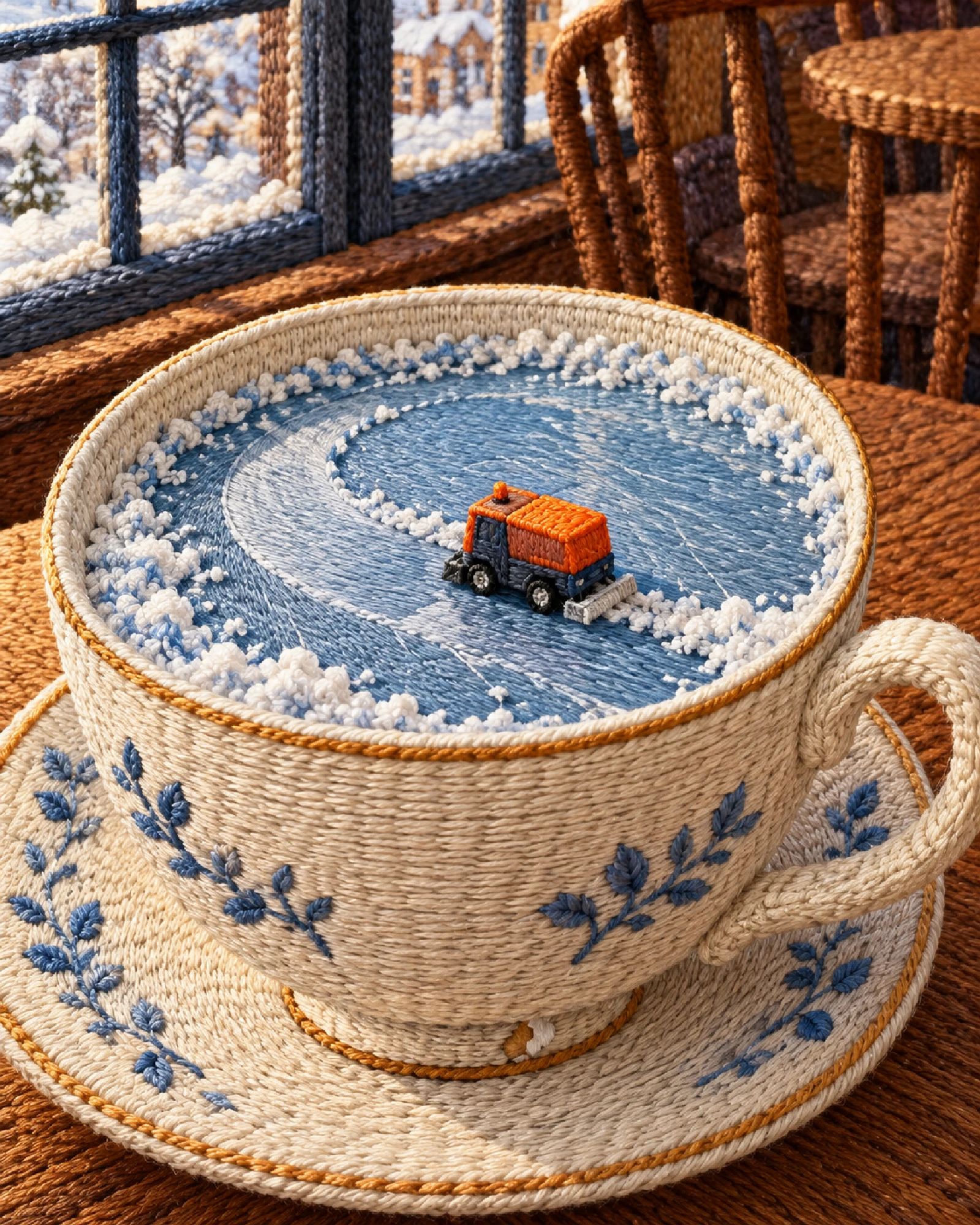
A Skating Rink Inside a Teacup
Inside a café teacup, a tiny ice resurfacer leaves a smooth curve across a miniature rink. Directional stitches and thread relief distinguish porcelain, ice and loose snow.
Remix this referenceA Skating Rink Inside a Teacup
- Form language
- Translate shapes into softly rounded textile patches, simplifying small mechanisms into readable blocks with natural handmade variation.
- Contour
- Use lightly irregular couched-thread outlines, thickening selected boundaries while allowing neighboring stitched fields to meet without outlines.
- Mark-making
- Turn satin stitches with each plane, use longer crossing strands for broad surfaces and loose loop stitches for scattered granular details.
- Surface rendering
- Build shallow padded relief beneath dense stitched areas; interleave thread tones for gradual transitions and leave occasional backing visible.
Priority
The finished illustration must visibly read as embroidery through directional stitches and raised thread relief.
What to avoid & what to check
Exact prompt for this example
MODULE OWNERSHIP
subject: Subject count, type, stable proportions and landmarks, resting face geometry, hair shape, physical materials, garment construction and permanent marks. No emotion, movement, color assignment or rendering recipe.
expression: Facial soft-tissue displacement and pupil direction, muscle coordination, regional intensity, asymmetry and onset/peak/release. No head/body pose, stable appearance, skin color or rendering.
gesture: Head/neck/body/limb orientation, joint movement, support, contact and pose-caused occlusion using existing anatomy. No eye/pupil movement, emotion, identity, props inventory or camera.
props: Prop count, type, construction, physical material and scale relative to the subject. Holding/contact belongs to gesture, position to composition, color to palette.
scene: Environment elements, terrain, backdrop/floor presence and structural detail. No canvas positions, camera, lighting, assigned colors or render texture.
camera: Projection, focal-length impression, camera elevation/yaw/roll, viewing distance and crop. No actor pose, world placement, lighting or canvas aspect ratio.
composition: Normalized 0-100% canvas positions, scale in frame, depth/overlap, focal hierarchy and margins. No joint pose, camera projection, rendering, subject/prop inventory or emotion.
palette: Color anchors, hue/saturation/value ranges, colors assigned to parts and approximate color coverage. No illumination direction, shading algorithm, physical material or layout.
lighting: Light-source direction/softness/intensity, ambient illumination, physical shadow direction/length and highlight position. Absence of directional illumination is allowed. No shading technique, palette or material changes.
style: Reusable form abstraction, contour weight/taper/edge quality, medium and mark scale/density/direction, surface rendering and tonal transition technique. No fixed subject proportions, anatomy, identity, expression, pose, palette, light-source direction, camera or layout.
output: Image count, aspect ratio, size, file/alpha requirements and global lettering/logo/watermark restrictions. No background scenery, crop, style, identity or pose.

SUBJECT
inventory: One ordinary-sized porcelain teacup; no people or animals.
geometry: A broad rounded bowl has a gently flared rim, a low foot and one generous loop handle.
resting-face: No facial features apply.
appearance: Glazed porcelain with a plain rim and a small permanent chip in the foot.

PRIORITY


AVOID


CHECK


PROPS
inventory: One matching saucer and one miniature ice resurfacing vehicle, small enough to cross the cup several times.
construction: The saucer is shallow porcelain; the vehicle has a compact metal body, enclosed cab, rubber wheels and an underbody blade.

PRIORITY


AVOID


CHECK


SCENE
inventory: A café window bay with a wooden tabletop, spindle-back chairs and a mullioned window; a miniature ice rink fills the cup.
structure: Ice reaches just below the rim; a curved cleared strip is bordered by loose ice shavings, with no liquid drink visible.

PRIORITY


AVOID


CHECK


CAMERA
projection: Natural perspective with a normal focal-length impression and modest depth compression.
viewpoint: An elevated three-quarter view reveals the ice surface and the cup's outer wall without camera roll.
crop: Use an intimate tabletop view, retaining the cup and handle while allowing the saucer and distant furniture to be cropped.

PRIORITY


AVOID


CHECK


COMPOSITION
placement: Place the cup around 62% across and 65% down; make the tiny vehicle and its curved trail the focal discovery.
depth: The saucer overlaps the lower edge, the cup obscures part of a chair, and the window establishes a separate rear plane.
spacing: Let the cup span about two-thirds of the image width; retain a clear interval around the vehicle and a narrow café glimpse above.

PRIORITY


AVOID


CHECK


PALETTE
colors: Use warm ivory, glacier blue, burnt orange, muted walnut brown and small slate accents.
assignment: Assign ivory to porcelain and snow, blue to ice, orange to the vehicle, brown to furniture and slate to window framing.
balance: Ivory and brown form the broad color fields; blue creates a cool inset and orange supplies a small vivid interruption.

PRIORITY


AVOID


CHECK


LIGHTING
sources: Soft window light enters from the upper left, with enough side direction to reveal shallow relief.
shadows: The cup casts a soft shadow to the lower right; raised details create short, delicate shadows in the same direction.
highlights: Broad highlights follow the upper-left rim and the vehicle roof; keep the ice highlights restrained.

PRIORITY


AVOID


CHECK


STYLE GUIDE
form-language: Translate shapes into softly rounded textile patches, simplifying small mechanisms into readable blocks with natural handmade variation.
contour: Use lightly irregular couched-thread outlines, thickening selected boundaries while allowing neighboring stitched fields to meet without outlines.
mark-making: Turn satin stitches with each plane, use longer crossing strands for broad surfaces and loose loop stitches for scattered granular details.
surface-rendering: Build shallow padded relief beneath dense stitched areas; interleave thread tones for gradual transitions and leave occasional backing visible.

PRIORITY
The finished illustration must visibly read as embroidery through directional stitches and raised thread relief.

AVOID


CHECK


OUTPUT
format: One finished image, 4:5 aspect ratio, 1600 × 2000 pixels, opaque PNG; no lettering, logos or watermarks.
restrictions: One finished image, 4:5 aspect ratio, 1600 × 2000 pixels, opaque PNG; no lettering, logos or watermarks.

PRIORITY


AVOID


CHECK


FINAL INTEGRATION
lighting + style: Let the illumination reveal the textile relief while the stitch directions distinguish adjacent surfaces.
Model information comes from image provenance. The same prompt may produce a different result.