Text to imageCharacterStyle guide
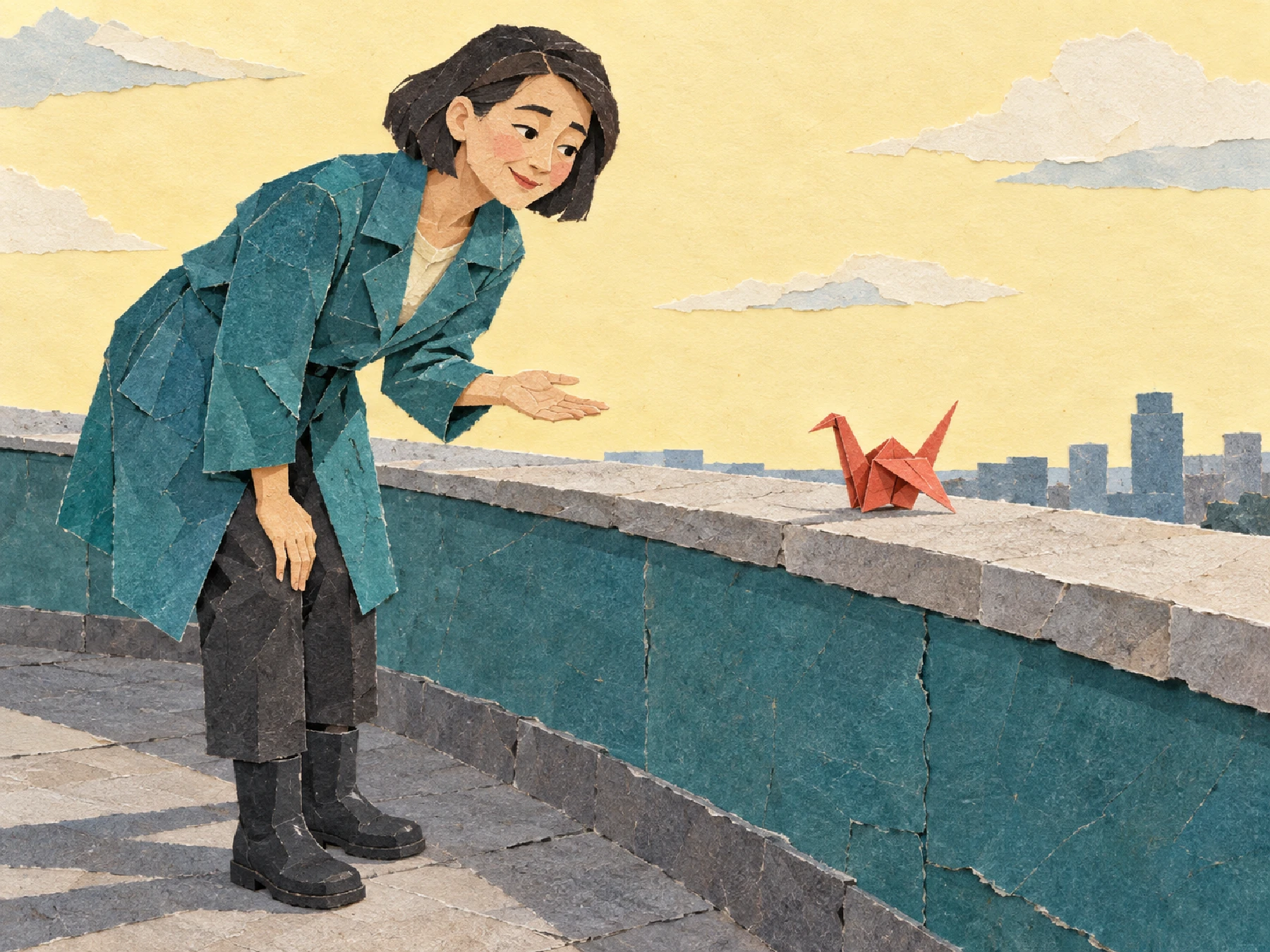
Woman Greeting a Paper Crane
A woman in work clothes bows politely to a paper crane on a low rooftop wall. An off-center figure and generous open sky make a playful character scene in tactile layered paper.
Remix this referenceWoman Greeting a Paper Crane
- Form language
- Translate forms into interlocking cut silhouettes and a few folded planes, allowing playful irregularity within each shape family.
- Contour
- Use slightly wandering scissor edges, occasional torn interruptions and narrow exposed borders between layers.
- Mark-making
- Keep embedded paper fibers and sparse rubbed-pencil accents; vary their strength naturally instead of applying uniform texture.
- Surface rendering
- Build tones from overlapping matte paper pieces, with lifted edges and occasional translucent scraps making the layers tactile.
Priority
The finished image must visibly read as layered cut-paper collage.
What to avoid & what to check
Exact prompt for this example
MODULE OWNERSHIP
subject: Subject count, type, stable proportions and landmarks, resting face geometry, hair shape, physical materials, garment construction and permanent marks. No emotion, movement, color assignment or rendering recipe.
expression: Facial soft-tissue displacement and pupil direction, muscle coordination, regional intensity, asymmetry and onset/peak/release. No head/body pose, stable appearance, skin color or rendering.
gesture: Head/neck/body/limb orientation, joint movement, support, contact and pose-caused occlusion using existing anatomy. No eye/pupil movement, emotion, identity, props inventory or camera.
props: Prop count, type, construction, physical material and scale relative to the subject. Holding/contact belongs to gesture, position to composition, color to palette.
scene: Environment elements, terrain, backdrop/floor presence and structural detail. No canvas positions, camera, lighting, assigned colors or render texture.
camera: Projection, focal-length impression, camera elevation/yaw/roll, viewing distance and crop. No actor pose, world placement, lighting or canvas aspect ratio.
composition: Normalized 0-100% canvas positions, scale in frame, depth/overlap, focal hierarchy and margins. No joint pose, camera projection, rendering, subject/prop inventory or emotion.
palette: Color anchors, hue/saturation/value ranges, colors assigned to parts and approximate color coverage. No illumination direction, shading algorithm, physical material or layout.
lighting: Light-source direction/softness/intensity, ambient illumination, physical shadow direction/length and highlight position. Absence of directional illumination is allowed. No shading technique, palette or material changes.
style: Reusable form abstraction, contour weight/taper/edge quality, medium and mark scale/density/direction, surface rendering and tonal transition technique. No fixed subject proportions, anatomy, identity, expression, pose, palette, light-source direction, camera or layout.
output: Image count, aspect ratio, size, file/alpha requirements and global lettering/logo/watermark restrictions. No background scenery, crop, style, identity or pose.

SUBJECT
inventory: Actor A is one original middle-aged woman; there are no other living subjects.
geometry: A has a long neck, broad cheeks, a gently hooked nose and an angular jaw beneath a compact bob.
resting-face: At rest, her brows are straight, eyes almond-shaped and mouth broad with level corners.
appearance: Her blunt bob has one tucked side; she wears a cotton work coat with broad lapels, ankle trousers and rubber boots.

PRIORITY


AVOID


CHECK


EXPRESSION — ACTOR A
brows: Both brows lift slightly, with the right brow a little higher.
lids: Upper lids stay relaxed; lower lids rise faintly without closing the eyes.
cheeks: A small cheek lift gathers more clearly on the right.
nose: The nose remains unwrinkled and the nostrils relaxed.
mouth: Closed lips form a modest smile, with the right corner slightly higher.
jaw: The jaw stays loosely closed, without chin tension.
gaze: Both pupils turn down and right toward the paper crane.
coordination: The mild brow lift and uneven smile cooperate as restrained amusement.
timing: Hold the apex of a small amused response, without escalating into laughter.

PRIORITY


AVOID


CHECK


GESTURE
head: A inclines her head toward the crane, keeping her neck continuous with the bow.
torso: She bows forward from the waist with softly bent knees and weight supported by both feet.
limbs: One forearm opens beside her waist with the palm upward; the other arm follows the forward thigh.
contact: Both boots meet the roof; one hand rests lightly on her thigh, and neither hand touches the crane.

PRIORITY


AVOID


CHECK


PROPS
inventory: One folded paper crane, approximately the size of A’s open palm.
construction: A single paper sheet forms a pointed beak, raised wings and a narrow folded tail.

PRIORITY


AVOID


CHECK


SCENE
inventory: An open rooftop with a low parapet, a simple floor and uninterrupted sky.
structure: The parapet has a broad coping slab; a few roof joints provide sparse architectural detail.

PRIORITY


AVOID


CHECK


CAMERA
projection: A shallow orthographic view keeps the scene pictorial rather than strongly foreshortened.
viewpoint: View from slightly above the wall in a three-quarter direction, with no camera roll.
crop: Show A’s full figure and the wall top, allowing the parapet to continue beyond the frame.

PRIORITY


AVOID


CHECK


COMPOSITION
placement: A occupies the left third; the crane sits on the wall just right of the middle.
depth: A overlaps the near end of the parapet; the crane remains silhouetted against open sky.
spacing: Her face leads to the small crane; broad upper-right breathing room makes their uneven scale playful.

PRIORITY


AVOID


CHECK


PALETTE
colors: Petrol teal, coral, pale butter and charcoal create a restrained palette with one lively accent.
assignment: Teal colors the coat and wall; coral colors the crane; butter colors the sky; charcoal colors hair and boots.
balance: Pale fields dominate; medium teal anchors the forms, with warm peach skin and only a small coral accent.

PRIORITY


AVOID


CHECK


LIGHTING
sources: Soft daylight comes broadly from the upper right, with ample ambient illumination.
shadows: Gentle shadows fall leftward across the roof; overlap shadows remain short and quiet.
highlights: Subtle highlights touch the right-facing cheek, coat edges and wall coping.

PRIORITY


AVOID


CHECK


STYLE GUIDE
form-language: Translate forms into interlocking cut silhouettes and a few folded planes, allowing playful irregularity within each shape family.
contour: Use slightly wandering scissor edges, occasional torn interruptions and narrow exposed borders between layers.
mark-making: Keep embedded paper fibers and sparse rubbed-pencil accents; vary their strength naturally instead of applying uniform texture.
surface-rendering: Build tones from overlapping matte paper pieces, with lifted edges and occasional translucent scraps making the layers tactile.

PRIORITY
The finished image must visibly read as layered cut-paper collage.

AVOID


CHECK


OUTPUT
format: One finished image, landscape 4:3, 1800 × 1350 pixels, opaque PNG.
restrictions: No lettering, logos or watermarks.

PRIORITY


AVOID


CHECK


FINAL INTEGRATION
expression + style: Use economical paper shapes to preserve the small facial asymmetry without adding unnecessary features.
Model information comes from image provenance. The same prompt may produce a different result.