Text to imageCafe & brandStyle guide
Sofa Around the Stair Turn
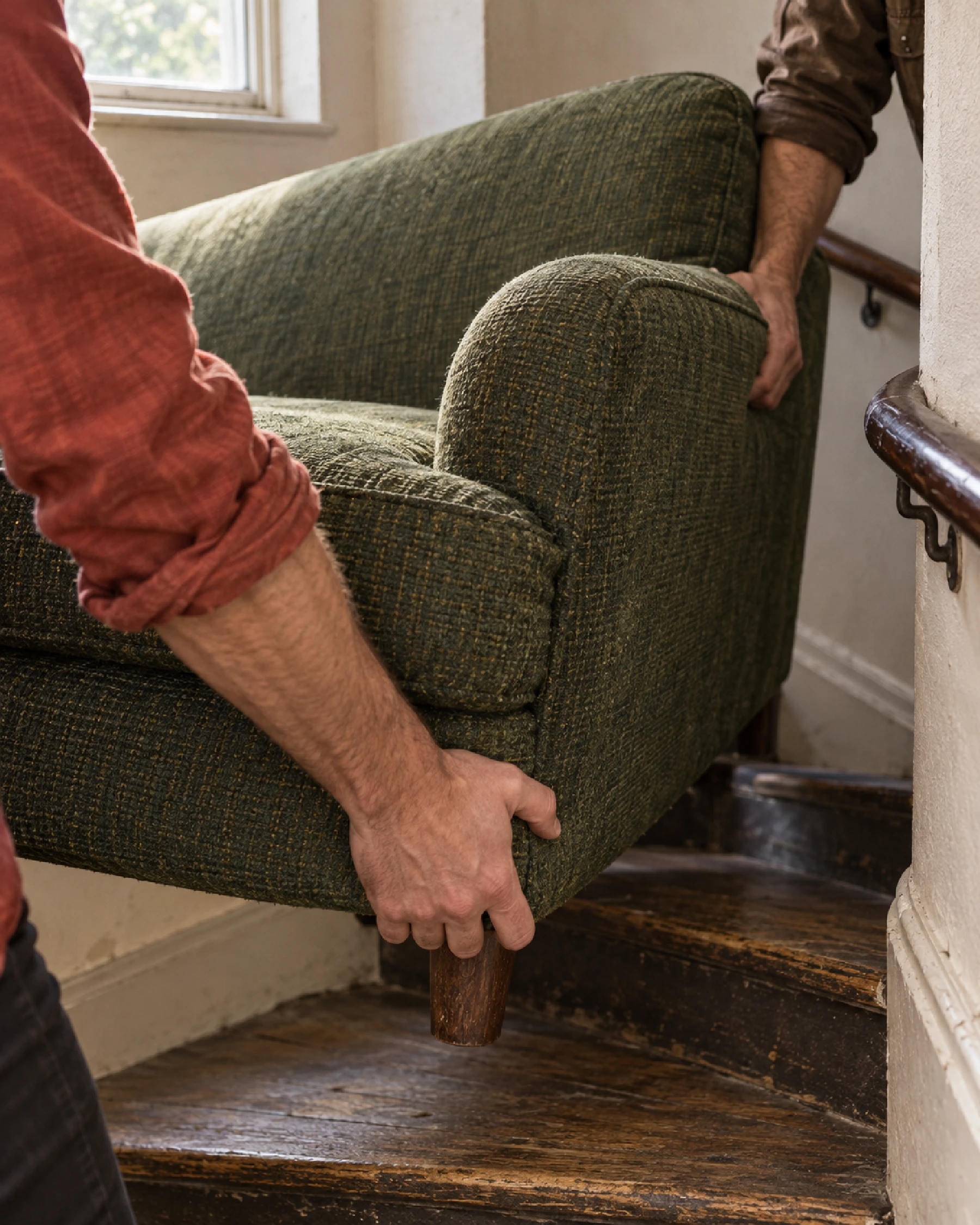
A moving-service campaign photograph: overlapping hands guide a sofa around a narrow stair turn, giving shared effort the depth and lived-in warmth of analog photography.
Remix this referenceSofa Around the Stair Turn
- Form language
- Keep photographic volumes observational and slightly irregular; retain everyday dents and wrinkles instead of idealizing the objects.
- Contour
- Let edges arise from photographic separation, with gently softened transitions and occasional crisp fabric fibers rather than drawn outlines.
- Mark-making
- Use irregular fine film grain with slight variation between dense and open areas; avoid a uniformly applied digital texture layer.
- Surface rendering
- Use rounded analog tonal transitions, gentle bright-edge halation and subtle dye softness while preserving tactile fabric detail.
Priority
Make the analog photographic treatment visibly convincing through organic grain and supple tonality.
What to avoid & what to check
Exact prompt for this example
MODULE OWNERSHIP
subject: Subject count, type, stable proportions and landmarks, resting face geometry, hair shape, physical materials, garment construction and permanent marks. No emotion, movement, color assignment or rendering recipe.
expression: Facial soft-tissue displacement and pupil direction, muscle coordination, regional intensity, asymmetry and onset/peak/release. No head/body pose, stable appearance, skin color or rendering.
gesture: Head/neck/body/limb orientation, joint movement, support, contact and pose-caused occlusion using existing anatomy. No eye/pupil movement, emotion, identity, props inventory or camera.
props: Prop count, type, construction, physical material and scale relative to the subject. Holding/contact belongs to gesture, position to composition, color to palette.
scene: Environment elements, terrain, backdrop/floor presence and structural detail. No canvas positions, camera, lighting, assigned colors or render texture.
camera: Projection, focal-length impression, camera elevation/yaw/roll, viewing distance and crop. No actor pose, world placement, lighting or canvas aspect ratio.
composition: Normalized 0-100% canvas positions, scale in frame, depth/overlap, focal hierarchy and margins. No joint pose, camera projection, rendering, subject/prop inventory or emotion.
palette: Color anchors, hue/saturation/value ranges, colors assigned to parts and approximate color coverage. No illumination direction, shading algorithm, physical material or layout.
lighting: Light-source direction/softness/intensity, ambient illumination, physical shadow direction/length and highlight position. Absence of directional illumination is allowed. No shading technique, palette or material changes.
style: Reusable form abstraction, contour weight/taper/edge quality, medium and mark scale/density/direction, surface rendering and tonal transition technique. No fixed subject proportions, anatomy, identity, expression, pose, palette, light-source direction, camera or layout.
output: Image count, aspect ratio, size, file/alpha requirements and global lettering/logo/watermark restrictions. No background scenery, crop, style, identity or pose.

SUBJECT
inventory: Two adult movers; individual identities remain unspecified.
geometry: Use ordinary adult hand and forearm construction, with broad palms and naturally varied finger lengths.
resting-face: Resting facial geometry is left unspecified.
appearance: Bare hands emerge from rolled canvas work sleeves; small differences in wear may vary naturally.

PRIORITY


AVOID


CHECK


GESTURE
head: Head and neck orientation is left unspecified.
torso: Torso orientation is left unspecified.
limbs: One pair of forearms lifts while the other draws back, making the shared turning action legible.
contact: Hands support the sofa beneath its lower rail and brace its upholstered corner, visibly compressing the padding.

PRIORITY


AVOID


CHECK


PROPS
inventory: One compact two-seat sofa, large enough to require both movers.
construction: A curved padded back joins low arms, woven upholstery and short solid-timber feet; the fabric has ordinary use wear.

PRIORITY


AVOID


CHECK


SCENE
inventory: A narrow apartment stairwell contains a timber landing, stairs, a handrail and a small window.
structure: Rounded plaster walls enclose a tight stair turn; scuffed skirting and a worn landing suggest an inhabited building.

PRIORITY


AVOID


CHECK


CAMERA
projection: Use a natural 50mm photographic perspective, focusing on the hands and upholstery with softer distant detail.
viewpoint: Photograph obliquely along the stair turn from landing height, keeping the horizon level.
crop: Crop both movers to forearms and hands around the sofa corner, retaining enough stair junction to explain the maneuver.

PRIORITY


AVOID


CHECK


COMPOSITION
placement: The sofa sweeps from the lower left across the middle; the compressed corner and supporting hands lead the image.
depth: A near forearm overlaps the sofa, which interrupts the receding handrail; the second pair of hands emerges beyond it.
spacing: Keep the working area tightly interlocked and leave a quiet wedge of wall above the diagonal mass.

PRIORITY


AVOID


CHECK


PALETTE
colors: Anchor the image in weathered moss, paprika, chalk beige and muted cocoa, with natural skin hues.
assignment: Give the sofa moss upholstery, one set of sleeves paprika and the other cocoa; use chalk beige for plaster.
balance: Let restrained moss and beige dominate, with the paprika sleeves supplying a concentrated warm accent.

PRIORITY


AVOID


CHECK


LIGHTING
sources: Broad window light arrives from the upper left, with soft ambient bounce retaining detail beneath the sofa.
shadows: Soft shadows fall rightward across the landing, becoming denser at the hands' contact points.
highlights: Broad highlights skim the upper upholstery ridge and exposed knuckles without clipping their detail.

PRIORITY


AVOID


CHECK


STYLE GUIDE
form-language: Keep photographic volumes observational and slightly irregular; retain everyday dents and wrinkles instead of idealizing the objects.
contour: Let edges arise from photographic separation, with gently softened transitions and occasional crisp fabric fibers rather than drawn outlines.
mark-making: Use irregular fine film grain with slight variation between dense and open areas; avoid a uniformly applied digital texture layer.
surface-rendering: Use rounded analog tonal transitions, gentle bright-edge halation and subtle dye softness while preserving tactile fabric detail.

PRIORITY
Make the analog photographic treatment visibly convincing through organic grain and supple tonality.

AVOID


CHECK


OUTPUT
format: Deliver one finished 4:5 image at 1800 × 2250 pixels as an opaque PNG.
restrictions: Include no lettering, logos, watermarks or campaign slogans.

PRIORITY


AVOID


CHECK


FINAL INTEGRATION
gesture + props + composition: Contact and overlap should make the shared task immediately understandable.
camera + lighting + style: Optical depth, broad illumination and analog transitions cooperate to make the moment feel encountered.
Model information comes from image provenance. The same prompt may produce a different result.